Weather radar is one of the most important investments an organization can make in its meteorological infrastructure. It is also one of the most complex. The right system delivers decades of high-resolution data, reliable early warnings, and a sustainable operational asset that grows with your needs. The wrong one means coverage gaps, degraded data when it matters most, and a system that is ultimately unreliable for your needs.
This guide walks through every major consideration in the radar selection process — frequency band, transmitter type, power, antenna size, dual-polarization, and site selection — so decision-makers can move forward with clarity and confidence.
Start Here: Which Radar Is Right for You?
No two environments are the same, and neither is the radar that serves them best. Before diving into the technical detail, the table below maps common operational situations to the most appropriate radar starting point.
|
Your situation |
Recommended starting point |
|
Tropical or sub-tropical region, frequent heavy rain or flooding |
S-Band — lowest rain fade, greatest-range QPE, ideal for early warning systems |
|
General national or regional meteorological network |
C-Band — best balance of performance, range, and cost; most globally deployed |
|
Mobile deployment or research applications |
X-Band — compact, transportable, high short-range precision |
|
Gap-fill in an existing network |
C-Band — proven for targeted |
|
Mountainous or complex terrain |
Transportable C-Band; Baron site survey recommended |
|
Dual-polarization required |
Any band — Baron offers dual-pol across S, C, and X; higher power recommended |
Frequency: Choosing Your Band
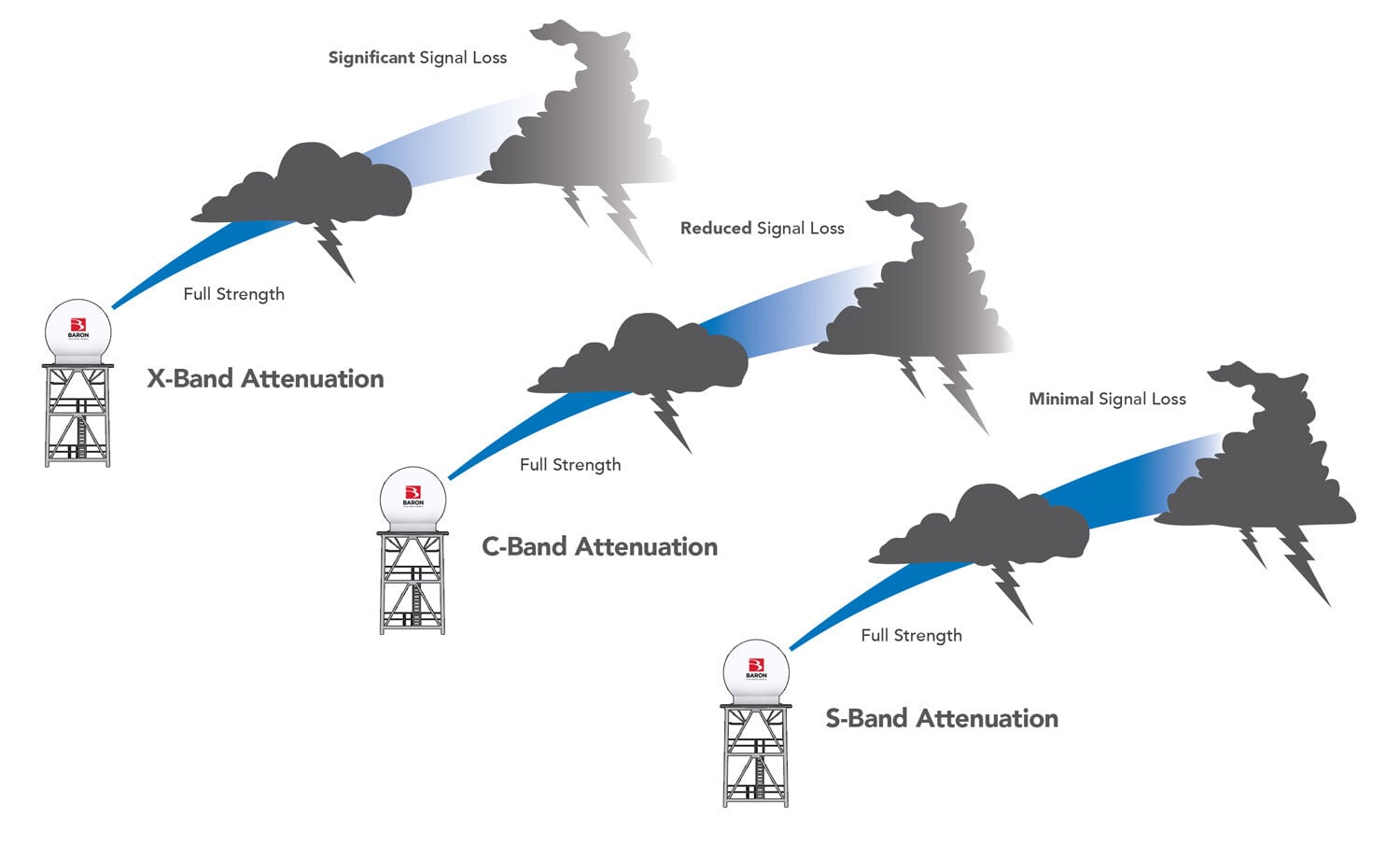
Frequency — the radar's "band" — shapes range, resolution, sensitivity, and how well the system performs when weather is at its worst. S-band excels in heavy rain and greater-range flood detection, C-band offers the best balance of performance and cost for national networks, and X-band delivers fine resolution at short range for mobile and specialized applications.
The core trade-off is this: higher frequency means finer resolution and greater sensitivity, but it also means the signal is more vulnerable to rain fade — the signal loss that occurs when the radar signal passes through heavy rain and hail. S-band's longer wavelength makes it far less susceptible to that signal loss. In the most intense precipitation events, that resistance to attenuation is what keeps the picture clear.
It is also worth noting that velocity detection — the radar's ability to accurately track storm movement and wind — varies meaningfully between bands. Due to the physics of lower frequency signals, S-band has a natural advantage in velocity detection at range, making it particularly well-suited for environments where storm tracking and early warning are critical.
S-Band
S-band operates at the lowest frequency of the three main bands and is the least susceptible to attenuation. In environments with frequent heavy rain, tropical convection, or significant flooding risk, this resistance to rain fade is operationally critical. S-band systems maintain accurate detection through the most intense precipitation events, at observation ranges up to 460 km and Quantitative Precipitation Estimation (QPE) out to 230 km.
S-band also delivers a substantial advantage in velocity data quality. Due to the physics of lower frequency signals, S-band produces significantly better storm tracking and wind data than C or X-band — a meaningful edge for agencies that rely on accurate velocity information for severe weather detection, tornado identification, and early warning decision-making.
For organizations where cost is a concern, it is worth understanding what actually drives up the cost of most S-band deployments — the antenna, not the radar itself. A larger antenna delivers better sensitivity but increases tower and infrastructure costs. Baron offers an S-band configuration with a smaller 6.1-meter diameter antenna that significantly lowers those costs with only a slight reduction in sensitivity. It is a practical path to S-band performance without the full infrastructure commitment.
C-Band
C-band is Baron's most widely deployed radar solution and represents the best balance of performance and cost for most national and regional meteorological networks. It delivers excellent range, strong sensitivity across a full range of weather types, and the flexibility to deploy in fixed and transportable configurations.
C-band does experience more attenuation than S-band in heavy precipitation — a known limitation that Baron addresses directly through advanced signal processing and attenuation correction technologies. For most networks, a well-configured C-band system is more than capable of meeting operational requirements across every scenario it will face.
X-Band
X-band radar operates at the highest frequency, offering fine resolution at short range. Its narrow wavelength excels at detecting sparse particles — making it particularly effective for snow and winter precipitation surveillance. Its compact size makes it well suited for mobile applications, transportable deployments, and research operations where portability and short-range precision are the priority.
The trade-off is range. X-band signals attenuate significantly in heavy rain, limiting effective observation to approximately 60 km. X-band works best as a complement to an existing S or C-band network rather than a standalone solution.
Baron offers straightforward upgrade paths across its radar portfolio — from single-polarization to dual-polarization, and from magnetron to solid-state transmitters — allowing organizations to modernize incrementally as budgets and operational needs evolve. That flexibility applies across both C-band and S-band systems. In fact, Baron has upgraded more S-band radars than any other manufacturer, including the U.S. NEXRAD network.
To see how the band decision plays out across three real-world situations, read The Radar Band Question Every Agency Asks — Answered in Three Scenarios.
Transmitters: The Engine of the System
The transmitter determines data quality, operational lifespan, and total cost of ownership. There are three main types in operational use today.
Magnetron
Magnetrons offer an excellent balance between performance and budget. Paired with solid-state modulation and modern digital components, they are effective across most meteorological environments and well-suited for organizations that need strong operational capability without the full capital commitment of a klystron system. For many deployments, a well-configured magnetron system is exactly the right answer.
Solid-State
Modern solid-state transmitters, built on gallium-nitride (GaN) power amplifiers, now deliver the range, sensitivity, and resolution once associated with high-power klystron and magnetron systems — without the high-voltage components, consumable tubes, and maintenance those technologies require. For many operational and research deployments, solid-state is no longer a compromise. It is the preferred choice.
Unlike vacuum tube-based systems, solid-state radars are designed with redundancy built in — if a single board fails, the system keeps running rather than going offline. Baron's patented Progressive Pulse Compression Plus (PPC+) technique also eliminates the traditional near-range blind spot without additional hardware, delivering consistent, calibrated data from close range to the edge of coverage. Lower maintenance demands and reduced operational costs over the life of the system round out the case.
Power: Why It Matters More Than You Might Think
Transmitter power has a greater effect on what a radar can see than most people expect. It determines not just how far a radar can see, but how clearly it sees at range — particularly the lighter fringes of precipitation at the outer edges of a storm system. Those fringes are often where the earliest warning signals live.
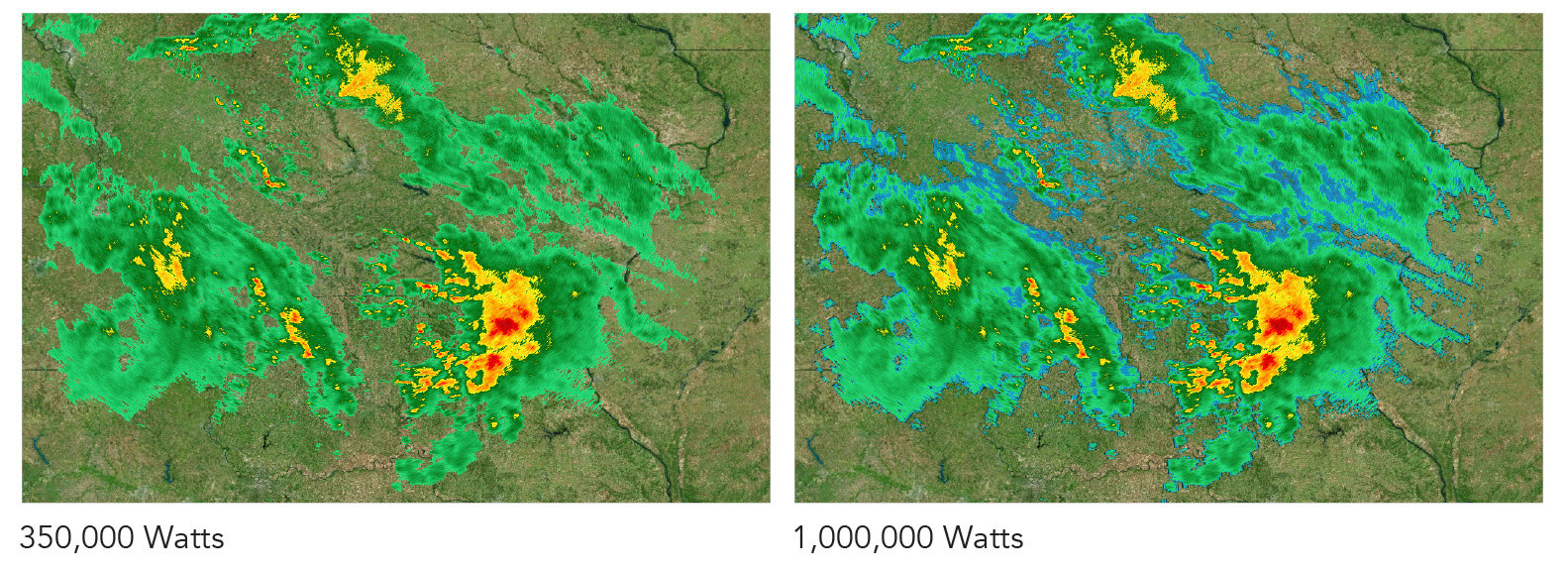
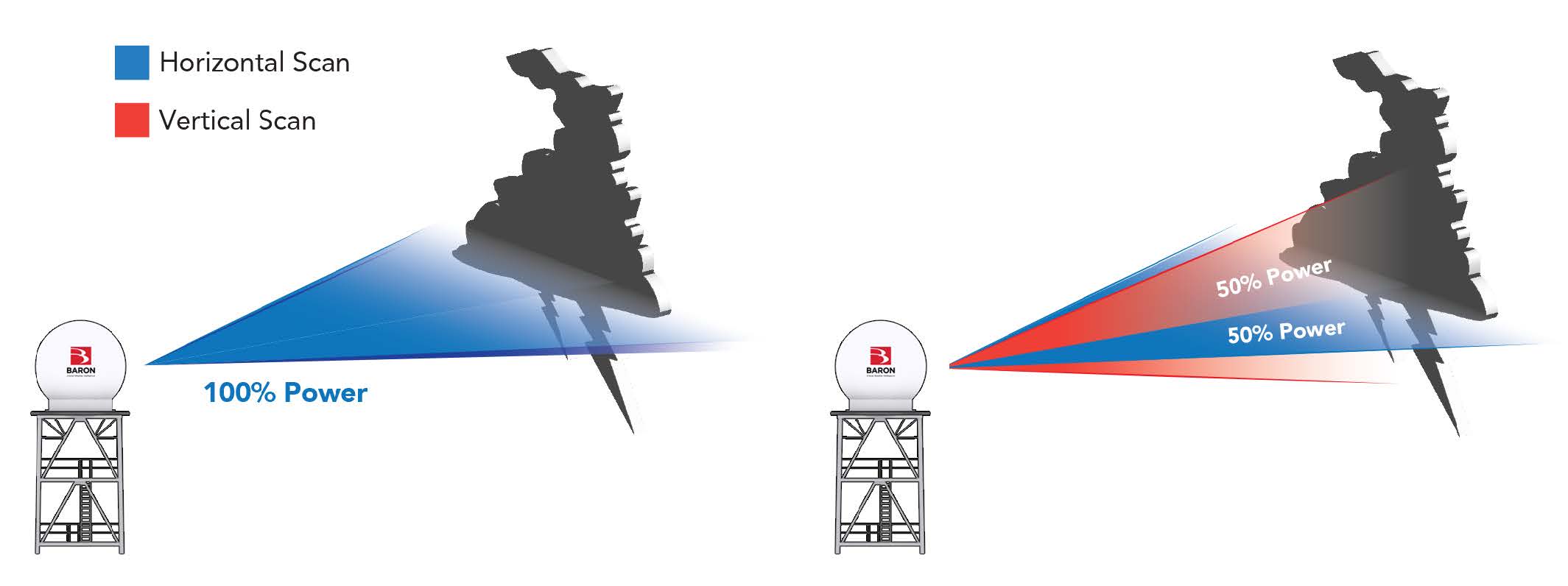
In coastal environments, where tropical systems and offshore convection need to be detected well before they make landfall, extended detection range can be the difference between adequate warning time and not enough. Power also becomes especially important in dual-polarization configurations, where the radar signal is split across two channels simultaneously. Each channel effectively operates at half the total transmit power, which means that higher total output keeps detection performance strong across both polarizations at range.
Antenna Size: The Variable Most Buyers Overlook
Antenna size is one of the most consequential variables in radar selection — and one of the least discussed. The size of the antenna determines how well the radar detects precipitation. A larger antenna delivers better sensitivity and finer beam resolution, but it also drives up tower height requirements and infrastructure costs significantly.
For organizations working within budget constraints, antenna size is often where meaningful cost management is possible without sacrificing core operational performance. Baron's radar team works with customers to identify the right antenna configuration for their coverage requirements and budget — including smaller antenna options that deliver strong performance at a lower infrastructure cost.
Dual-Polarization: Now Standard for Good Reason
Conventional radar transmits horizontally polarized pulses only. Dual-polarization systems transmit both horizontal and vertical pulses simultaneously, analyzing the returned echoes across both axes. The result is a significantly richer data picture — not just where precipitation is, but what it is.
The operational benefits are well established: more accurate distinction between heavy rain and hail, better quantification of flooding extent, improved winter precipitation forecasting, and highly accurate detection of tornado debris. Dual-pol data is also the foundation for a suite of value-added derived products that extend the operational utility of raw radar data considerably. For most organizations today, the question is not whether to invest in dual-polarization — it is which configuration makes the most sense for their environment. Baron offers dual-pol configurations across all three bands.
Site Selection: The Factor That Overrides Everything Else
Of all the considerations in this guide, site selection has the greatest single impact on radar performance. A state-of-the-art radar placed in a suboptimal location will consistently underperform a more modest system sited correctly.
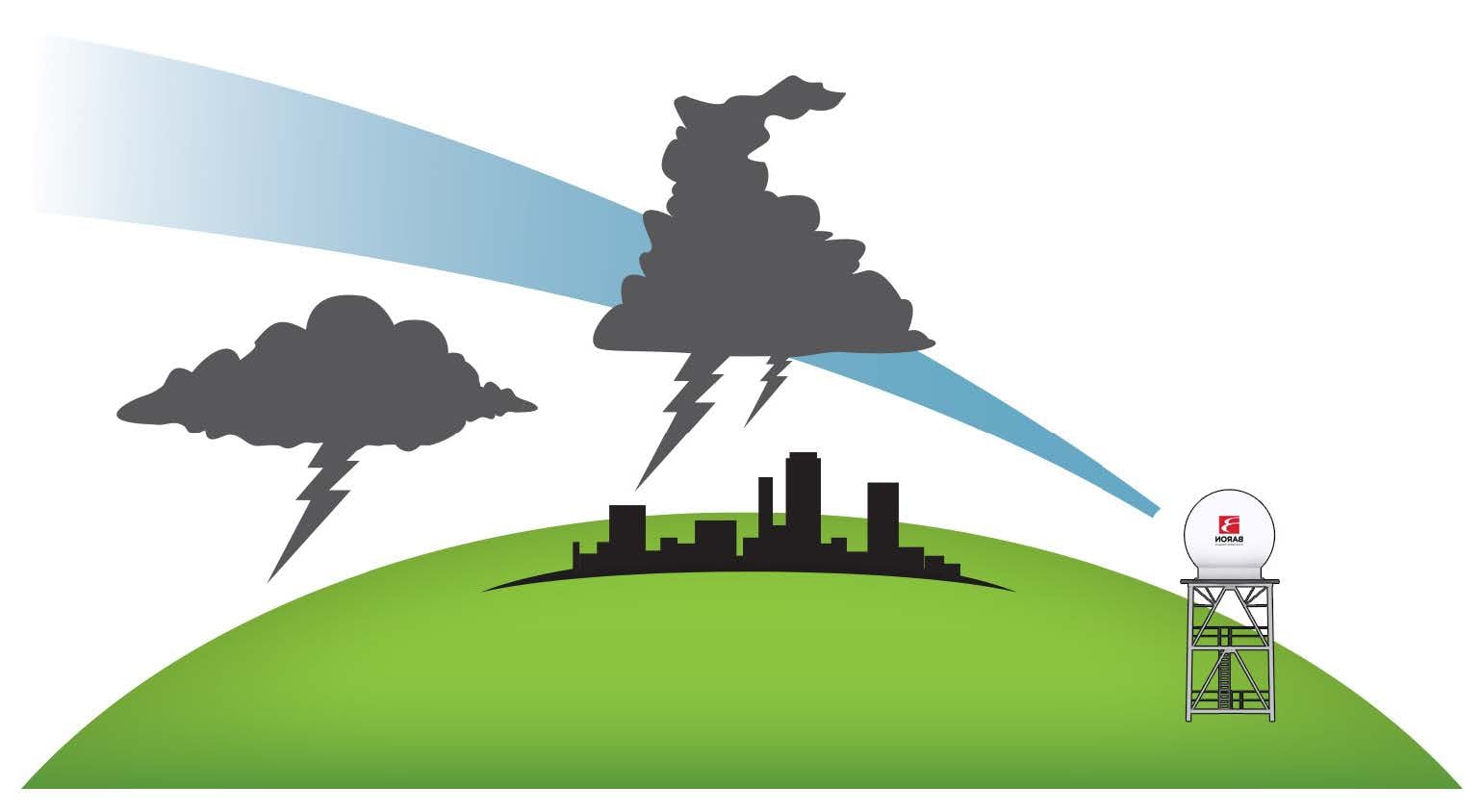
Mountains, large buildings, cellular towers, and other vertical obstructions create permanent blind sectors in the coverage area. Beyond obstructions, the distance between the radar and the monitored area is critical. As the signal travels from the antenna, it rises in altitude. At the correct distance — approximately 30 miles / 48 kilometers for most applications — the beam height is optimal for detecting precipitation at relevant altitudes. Too far and the beam overshoots low-level weather. Too close and the coverage area is too limited to be useful.
In mountainous or complex terrain where an ideal fixed site cannot be identified, a mobile or transportable radar is often the most practical solution. Baron performs detailed pre-installation site surveys that determine optimal tower height, antenna positioning, and siting geometry for each specific deployment — because getting this right from the start is far less expensive than remediating it later.
Sustainability and Total Cost of Ownership
A weather radar is a long-term infrastructure investment. Acquisition cost is only one component of total cost of ownership over a 20-year operating life. Baron designs its radar systems with long-term economics explicitly in mind — including transmitters built for 20 or more years of operational life, similar components across product lines to simplify spare parts and supply chain management, minimal power consumption, automated performance monitoring, and remote troubleshooting capability that reduces the cost and delay of on-site service visits.
Baron also offers seamless upgrade paths — including dual-polarization retrofits and magnetron to solid-state conversions — that extend the operational life of existing radar investments rather than requiring full system replacement.
Making the Right Decision
Weather radar selection is not a commodity purchase. The right system depends on geography, threat profile, data requirements, and long-term operational goals — and those variables interact in ways that are worth working through with an experienced partner before any commitment is made.
Baron has deployed more than 350 radars worldwide across every major climate and terrain type — national networks, airport installations, military applications, and early warning systems in some of the world's most flood-prone regions. We offer expert consultation and detailed site surveys before any commitment is made, because the right configuration for your environment is the only one worth building. Talk to an expert today.